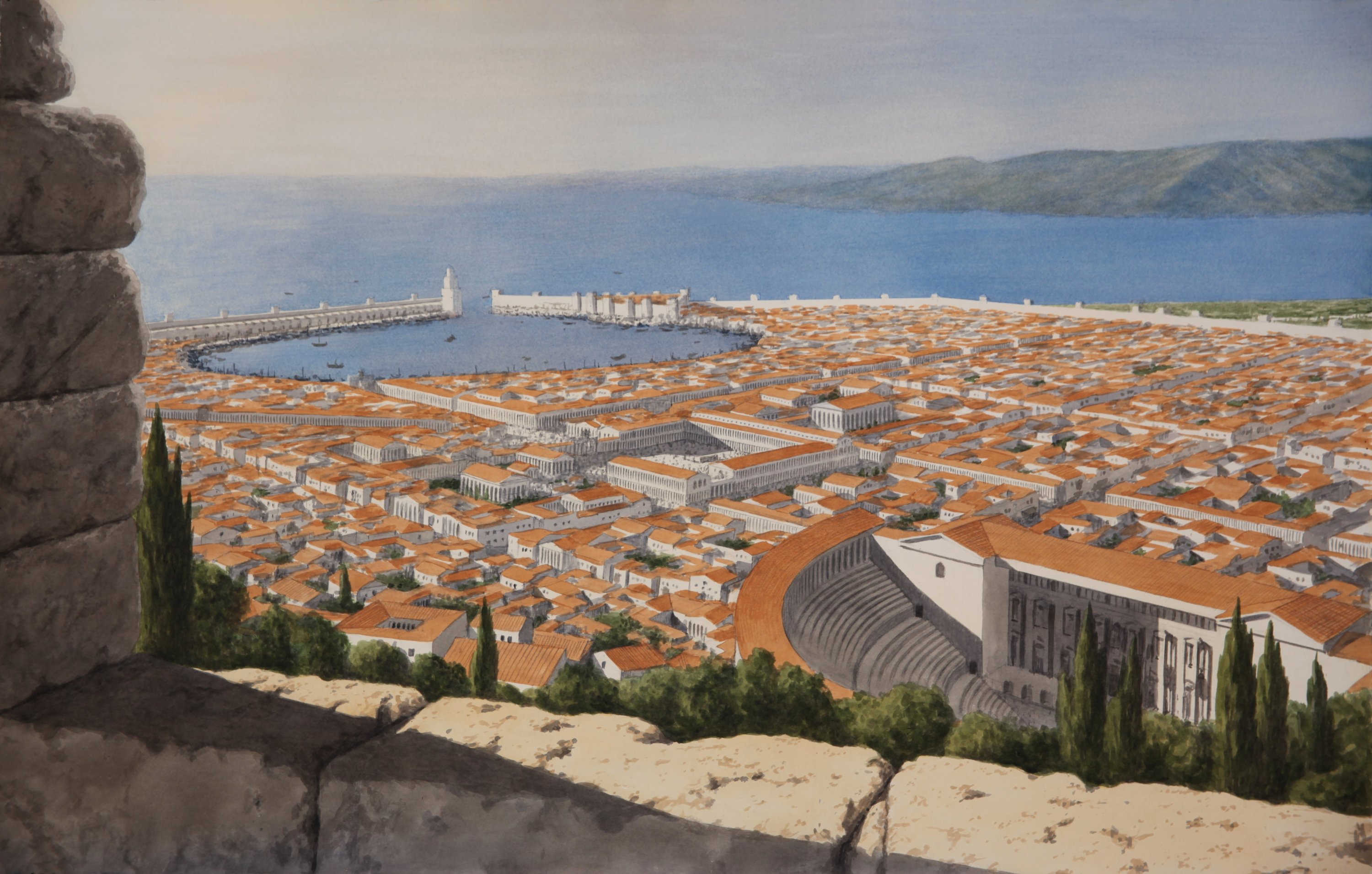
Smyrna, an ancient city now surrounded by the modern city of Izmir, was originally established around 1000 BC by Aeolian Greek settlers in “Old Smyrna” (Bayraklı Höyüğü) on a small peninsula jutting out from Asia Minor into the Aegean Sea, similar to Old Tyre. It was in this Old Smyrna that the famous Greek poet Homer, author of the epics the Iliad and the Odyssey, was probably born around 850 BC, and a shrine to Homer stood in the Roman period (Herodotus, Histories; Strabo, Geography; coins of Smyrna). Then, just after the time of Alexander the Great in the late 4th century BC, a “new” Smyrna was built by the Seleucids along the coast and up the slopes of Mount Pagos/Kadifekale (Strabo, Geography). This region eventually became part of Asia Province during the Roman period, and Smyrna, between Ephesus and Pergamum, developed into a wealthy port city and one of the most important cities of the province, with a population of nearly 100,000 residents (Yamauchi, New Testament Cities in Western Asia Minor). The original name of the settlement is unknown, but ancient legends claim that the city received the name “Smyrna” either from a myth about an Amazon named Smyrna who gave her name to the city and to a neighborhood of Ephesus, or perhaps less likely, but possibly related to the Greek word for “myrrh” (Strabo, Geography; Stephanus of Byzantium; Liddell et al., A Greek-English Lexicon).
During the Roman period, Smyrna was apparently a city of great beauty and impressive architecture that circled Mount Pagus like a “crown” (Philostratus, Apollonius of Tyana; Strabo, Geography; cf. Revelation 2:10 “crown of life”). Walking through the city, one would a see the Ephesian gate, a gymnasium (near harbor), a stadium (west side), a theater (holding 20,000 and located on the northwest mountain slope), temples to Zeus (including a large altar), Cybele (the Mother Goddess, near the harbor), Aphrodite, Dionysius, and the Emperors (probably Tiberius in 26 AD and Domitian before 96 AD), the harbor, a library, and a massive agora with a bema on the west and a basilica on the north (McRay, Archaeology and the New Testament; Strabo, Geography; Vitruvius; Jones, “Heracles at Smyrna”; Hasluck, “Dionysos at Smyrna”). As Smyrna was severely damaged by an earthquake in 178 AD, the Roman period city was repaired or rebuilt in the 2nd century AD, but most of the structures and layout are probably substantially the same as in the 1st century. This wealthy city was also known for its exceptionally good wine that could be used for both enjoyment and medicinal purposes (Strabo, Geography).
With a long history of ties to Rome, including an ancient alliance and a temple to Roma built in about 195 BC, Smyrna was an obvious choice for an imperial temple in Asia (Cicero, Pro Flacco). Along with the other cities of Asia Province, Smyrna competed for the honor of building a temple to Tiberius in 26 AD, winning the honor and becoming the “temple warden” of the imperial cult (Tacitus, Annals; Lewis, “Sulla and Smyrna”). In the 2nd century AD, Smyrna built another imperial temple to Hadrian. Along with inscriptions honoring the emperors and statues of Domitian and Trajan, coins issued by the city often depicted emperors and even the imperial temples, so it is obvious that Smyrna was dedicated to the worship of the emperor and the imperial cult.
In the book of Revelation, John addressed his second letter to Smyrna, as it was located just north of Ephesus and next on the semicircular route of the 7 churches of Asia Province (Revelation 1:11; McRay, Archaeology and the New Testament). The reference to Jesus as the one “who was dead, and has come to life” may have been used in the letter for this particular city due to its rebuilding and resurgence (Revelation 2:8). In the letter to Smyrna, John remarks that the Christians in Smyrna have experienced oppression and that they are “poor” but also rich, alluding to the reputation of the city as pagan and wealthy (Revelation 2:8-9). The letter then goes on to mention blasphemy by Jews who are actually part of a “synagogue of Satan,” and in the future that some of the Christians will be thrown into prison, but that they must be faithful until death (Revelation 2:9-10). Written during the time of Domitian and Christian persecution, the church at Smyrna faced even more opposition than most, due to the strong influence of emperor worship in the city, which at that time was required by law and punishable by imprisonment or death. An interpretation of the reference to the “synagogue of Satan” is tentative, but it may refer to Jews who not only opposed Christianity, but also participated in the imperial cult. Like many other cities of Asia Minor, there was a significant community of Jews, including at least one synagogue (Revelation 2:9; Josephus, Antiquities). Unfortunately, many of these Jews were fiercely opposed to Christianity, and just as Paul and his friends had been opposed and attacked by Jews in other cities, the Christians in Smyrna also faced persecution from not only the pagans, but the Jews. Polycarp, who had known and been taught by John the Apostle, was martyred in Smyrna at the instigation of Jews in about 156 AD (Martyrdom of Polycarp; Eusebius, Ecclesiastical History). The 2nd century Church bishop and apologist Irenaeus was born in Smyrna, and knew Polycarp in his youth, although he relocated to Lyon in Gaul to lead the local church there.


Dr. Titus Kennedy is a field archaeologist working primarily with sites and materials related to the Bible. He works with ColdWater Media and Drive Thru History® to maintain historical accuracy throughout their scripts and locations. Many of the archaeology blog posts are based on his publications, including Unearthing the Bible, Excavating the Evidence for Jesus, and The Essential Archaeological Guide to Bible Lands.

